Click on the links above
Exercise 1
Write a structure to represent an element of the form a+sqrt(-2)b for integer values a and b. Write a C function that takes two such complex numbers and returns the product of these numbers in the same form.
Solution 1
   typedef struct {
      int a;
      int b;
   } comp2;

   comp2 mul ( comp2 z1 , comp2 z2 )
   {
      comp2 z;

      z.a = (z1.a)*(z2.a) - 2*(z1.b)*(z2.b);
      z.b = (z1.a)*(z2.b) + (z1.b)*(z2.a);
      return z;
   }
Exercise 2
Consider the following type definitions.
   typedef struct {
      char name[80];
      char rollno[8];
      float cgpa;
   } stud1;

   typedef struct {
      char *name;
      char *rollno;
      float cgpa;
   } stud2;

   typedef stud1 *stud1ptr;
   typedef stud2 *stud2ptr;

   typedef stud1 stud1arr[100];
   typedef stud2 stud2arr[100];
Assume that a pointer is of size 32 bits. Determine the following sizes:
   sizeof(stud1)
   sizeof(stud2)
   sizeof(stud1ptr)
   sizeof(stud2ptr)
   sizeof(stud1arr)
   sizeof(stud2arr)
Solution 2
   sizeof(stud1) = 80 + 8 + 4 = 92
   sizeof(stud2) = 4 + 4 + 4 = 12

   sizeof(stud1ptr) = 4
   sizeof(stud2ptr) = 4

   sizeof(stud1arr) = 92 x 100 = 9200
   sizeof(stud2arr) = 12 x 100 = 1200
Exercise 3
Write a C function that accepts a non-empty array of complex numbers and returns the array element having the maximum magnitude.
Solution 3
   typedef struct {
      double re;
      double im;
   } complex;

   complex maxmag ( complex A[] , int n )
   {
      int i, maxidx;
      double t, max;

      max = A[0].re * A[0].re + A[0].im * A[0].im;
      maxidx = 0;
      for (i = 1; i < n; ++i) {
         t = A[i].re * A[i].re + A[i].im * A[i].im;
         if (t > max) {
            max = t;
            maxidx = i;
         }
      }
      return A[maxidx];
   }
Exercise 4
What does the following program print? (Assume that an int is of size 32 bits.)
   #include <stdio.h>
   #include <stdlib.h>

   #define MAXDIM 100

   typedef int arr1[MAXDIM];

   typedef struct {
      int data[MAXDIM];
   } arr2;

   void f1 ( arr1 A )
   {
      A[0] = 12345;
   }

   void f2 ( arr2 A )
   {
      A.data[0] = 12345;
   }

   int main ()
   {
      arr1 A1;
      arr2 A2;

      printf("sizeof(A1) = %d\n", sizeof(A1));
      printf("sizeof(A2) = %d\n", sizeof(A2));
      A1[0] = 0; f1(A1); printf("A1[0] = %d\n", A1[0]);
      A2.data[0] = 0; f2(A2); printf("A2.data[0] = %d\n", A2.data[0]);

      exit(0);
   }
Solution 4
   sizeof(A1) = 400
   sizeof(A2) = 400
   A1[0] = 12345
   A2.data[0] = 0
Exercise 5
Suppose that we want to represent lists of the following form:
(a (b (c) (d e f)) (g h))
The first item of the list is the character a, whereas its second item is again a list (b (c) (d e f)), and the third item (g h) is a list too. The following figure depicts a possible representation of such list.
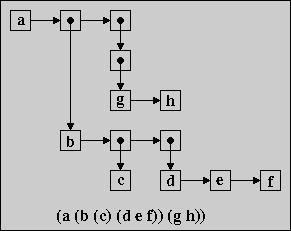
Define a suitable data type to represent such lists.
Write a function to print such a list with properly nested parentheses.
Solution 5
   typedef struct _node {
      int type;	                /* zero for character, nonzero for (sub)list */
      union {                   /* List item is a union of */
         char data;             /* either a character */
         struct _node *sublist; /* or a sublist */
      } item;
      struct _node *next;       /* pointer to the next item */
   } node;

   typedef node *list;

   void prnlist ( list L )
   {
      node *p;

      printf("(");
      p = L;
      while (p != NULL) {
         if (p -> type == 0) printf("%c", (p->item).data);
         else prnlist((p->item).sublist);
         p = p -> next;
         if (p != NULL) printf(" ");
      }
      printf(")");
   }